
We pulled data from over 6,500 objections logged across Pitchpilot in Q1 2026. The findings were clear enough that we had to share them publicly, because the most instinctive thing reps do under pressure is also the least effective.
The Most Common Objections SDRs Face
Before getting to what works, here's the distribution of what reps actually encountered:
- "Not interested": 40% of objections
- "Too busy / call me later": 33%
- "Not my department": 14%
- "We're happy with our current vendor": 9%
- "Too expensive": 4%
Timing and interest objections dominate. Budget objections, which most sales training spends a disproportionate amount of time on, represent just 4% of what SDRs actually face day to day. That mismatch between where reps are trained and where objections actually live is worth sitting with.
Three Approaches, Very Different Results
Pitchpilot categorizes how reps respond to objections into multiple patterns, such as:
- Deflection: Pivoting past the objection without acknowledging it ("Got it, the reason I'm actually calling is...")
- Acknowledge & Redirect: Validating the objection before pivoting ("That makes sense. A lot of teams I talk to say the same thing. What I've found is...")
- Reframing: Repositioning the conversation entirely, often by shifting what the objection is about
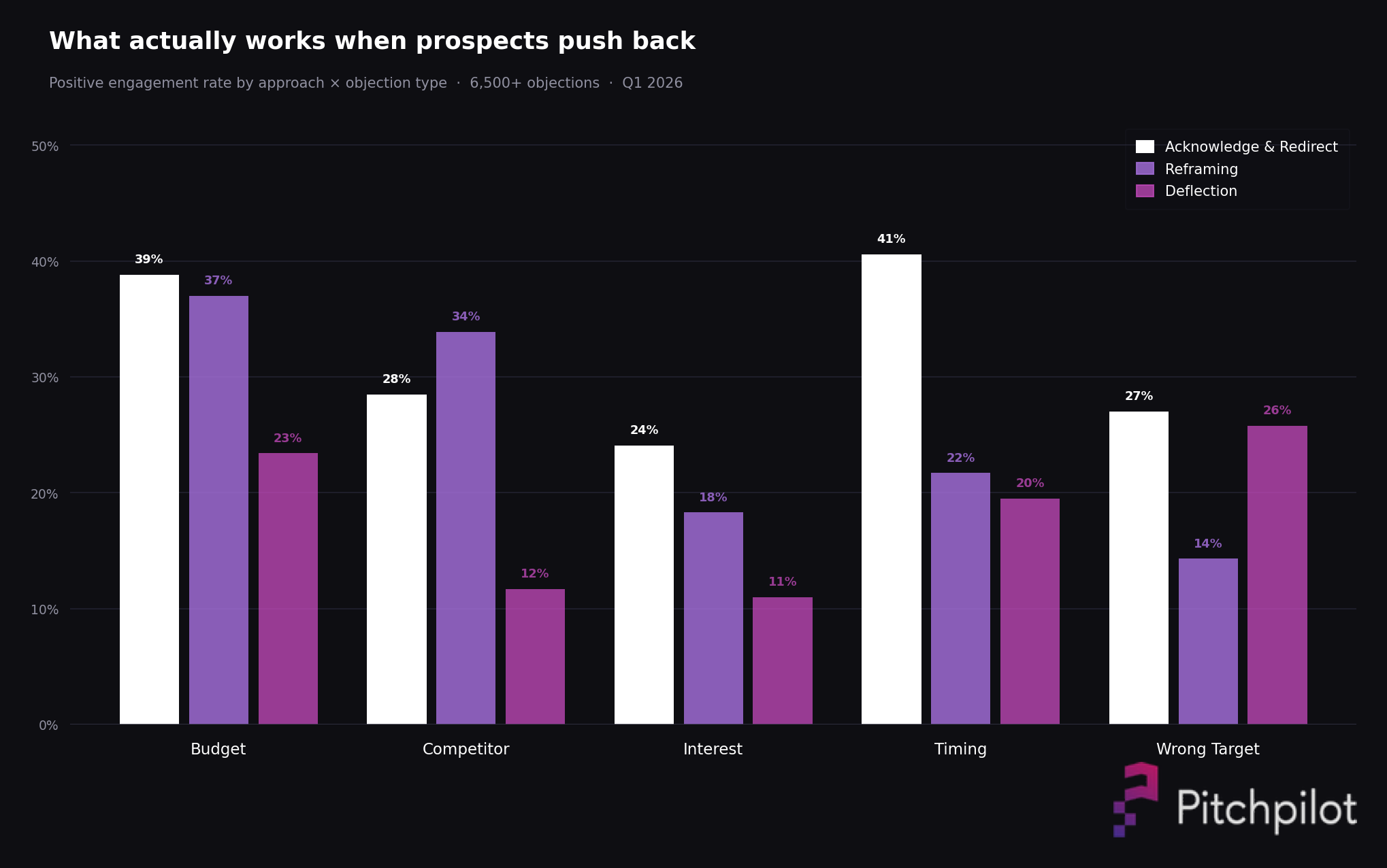
Deflection was the most used approach, applied in 45% of objections. It also had the lowest positive engagement rate at 17%.
Acknowledge & Redirect produced a 32% positive engagement rate — nearly double deflection — despite being used less often.
The Timing Gap Is the Starkest Finding
When a prospect says they're busy, the instinct is to get out of the way quickly: apologize, ask for a better time, move on. The data disagrees.
Reps who acknowledged the timing objection first by genuinely validating that it's a bad time before asking a short bridging question saw a 40.6% positive engagement rate.
Reps who deflected on timing: 19.5%.
That's more than a 2x difference on the most common objection type. The prospect is telling you something true (they are busy), and the moment you treat that as real instead of an obstacle to route around, the conversation changes.
Why Competitor Objections Are Different
For budget and timing objections, Acknowledge & Redirect outperforms everything. But for competitor objections like "we're already using someone for this," Reframing is the stronger move.
The reason is intuitive once you see it: a prospect who is already invested in a solution has already bought into the category. They're not skeptical of the need, they're satisfied with their current answer to it. Redirecting them toward a demo or a next step before addressing that satisfaction tends to fail. Reframing (shifting the conversation to what's missing, what's changed, or what they're not getting) is what opens the door.
A straight redirect when someone says "we already have a vendor" often reads as not listening. A repositioned value conversation shows you heard them.
What This Means for Your Reps
The aggregate pattern here maps to a simple principle: meet the objection before you move past it. Prospects can tell the difference between a rep who heard them and a rep who was waiting for them to finish talking.
Practically, this means:
- On timing objections: Acknowledge it directly before asking for anything. "I hear you. I'll be quick. The reason I'm calling right now specifically is..." performs materially better than jumping straight to the ask.
- On interest objections: Don't counter-assert. Validate that being uninterested makes sense before giving them a reason to reconsider.
- On competitor objections: Resist the impulse to pitch against the incumbent. Ask what's working about their current setup before repositioning around the gap.
- On budget objections: These are rare, but Acknowledge & Redirect outperforms deflection here too. Agreeing that budget is a real constraint and then reframing the ROI conversation works better than trying to remove the objection.
How Pitchpilot Surfaces These Insights
This data comes directly from Pitchpilot's call analysis layer. Every objection in a reviewed call is tagged by type, and every rep response is categorized by approach. Over time, that builds a picture of what's working at the individual rep level and across teams.
Pitchpilot doesn't just surface these patterns — it takes the next step. Using call data and proven frameworks, it formulates the actual messaging for reps: the specific language to use on a timing objection, how to reframe a competitor conversation, what to say after validating a budget concern. Reps don't have to figure it out from a chart.
A rep who deflects on timing 80% of the time usually doesn't know that's what they're doing. Pitchpilot identifies it, explains why it's costing them, and gives them something better to say next time.
Seeing the data changes that.
Methodology: 6,500+ objections analyzed from Pitchpilot-reviewed cold calls in Q1 2026. Positive engagement rate is defined as the prospect continuing the conversation beyond the objection point, whether agreeing to a next step, asking a follow-up question, or remaining meaningfully engaged.