
We analyzed roughly 10,000 cold calls. On 2 in 3, the rep glossed over at least one discovery cue: a question they didn't ask, or a signal the prospect handed them that they moved right past.
That number held across industries, team sizes, and experience levels. Discovery is the section of the cold call where reps leave the most on the table — by a significant margin. Here's what the data shows, and why it matters beyond the call itself.
What a Missed Cue Actually Is
A missed cue isn't a score or a vague flag. It's a specific moment: a question that wasn't asked when it should have been, or a piece of information the prospect offered that the rep didn't follow up on.
One of the more common patterns we see: a prospect mentions they mostly handle inbound leads, and the rep moves straight to an outbound pitch without asking a single question about it. How is inbound performing? What does your close rate look like on those leads? Is volume where you need it to be? Any one of those questions could have changed the direction of the conversation. Instead, the rep registered "inbound" as context and kept moving.
That's a missed cue. The prospect handed the rep an opening into their current situation, their priorities, and potentially their frustrations — and the rep moved past it to get to the pitch faster.
These aren't obvious mistakes in the moment. The rep wasn't checked out. They were managing the conversation, trying to keep things moving, and a meaningful signal slipped through.
That's the pattern. Multiply it across 10,000 calls and it becomes a data problem.
Where Missed Cues Show Up Most
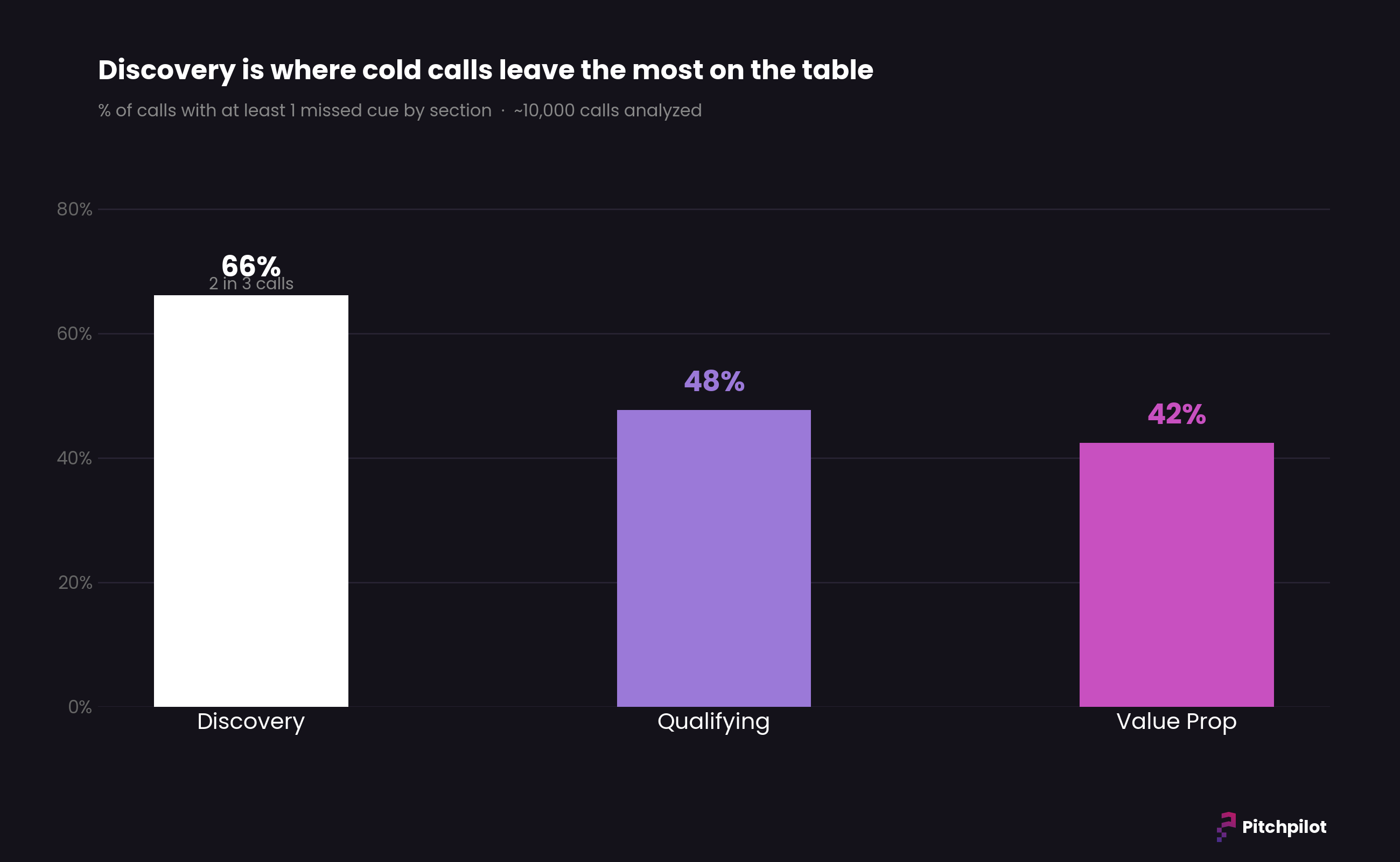
Pitchpilot analyzes calls across three sections: Discovery, Qualifying, and Value Prop. Here's how missed cue rates break down:
- Discovery: 66% of calls had at least one missed cue
- Qualifying: 48%
- Value Prop: 42%
Discovery isn't just slightly ahead. It's missed at more than double the rate of the other two sections on a per-cue basis, with an average of 1.04 missed cues per call compared to 0.52 in qualifying and 0.44 in value prop.
The reason discovery leads isn't that reps are less prepared there. It's that discovery is where reps are most focused on keeping the prospect engaged and building toward a pitch. Listening quality tends to drop when attention is split between hearing the prospect and managing where the conversation is going.
It's Not Just a Few Outliers
When you break the discovery numbers down further, the problem isn't concentrated in a small group of underperforming calls:
- 33.9% of calls had zero missed discovery cues
- 33.9% had one
- 26.7% had two
- 5.5% hit 3+
More than two-thirds of all calls had at least one missed cue in discovery. Nearly one-third had two or more. This isn't a tail-end coaching issue — it shows up consistently across the sample.
Why Discovery Specifically
Every section of a cold call has pressure on it, but discovery carries a particular kind. The rep is trying to establish credibility, keep the prospect from hanging up, ask questions without sounding scripted, and gather enough context to make the rest of the call land — all at once.
Under that pressure, reps tend to hear what they want to hear. A prospect answers a question in a way that sounds positive, and the rep moves forward without digging in. Or the prospect offers an unexpected piece of information — a role clarification, a process detail, a name — and the rep files it away rather than following up.
Sales teams call it "happy ears." The data shows it's not a personality trait. It's something that shows up on 2 in 3 calls.
The Handoff Problem Nobody Talks About
Most of the conversation around missed cues focuses on coaching: identify the gap, fix the rep, improve the next call. That's valid. But there's a second use case that's often overlooked.
When a BDR books a meeting and hands it off to an AE, context is lost. The AE gets a CRM note — interested, booked for next Tuesday — without knowing what was actually said on the call, what the prospect raised, what confusion came up, or what questions were left unanswered.
The missed cue record changes that. An AE who reviews the call before a meeting can immediately see what the BDR didn't get to: the decision-maker's name that was never confirmed, the process question that wasn't asked, the concern the prospect signaled that didn't get addressed. Discovery doesn't have to start from scratch on the follow-up — it can pick up exactly where the first call left off.
For teams running BDR-AE splits, this is one of the more practical applications of call analysis: not just as a coaching signal, but as a transfer document.
What This Means for Your Team
A few practical takeaways from the data:
- Don't treat discovery as pass/fail. Most reps aren't failing discovery — they're getting through 70% of it. The cues they miss tend to be ones that would have added context, not ones that would have broken the call.
- Coach to specific moments, not general habits. "Ask more questions in discovery" is too broad to act on. A specific missed cue — the prospect mentioned a second decision-maker and the rep didn't follow up — is something a rep can internalize and correct.
- Build missed cues into your handoff process. If your BDRs are booking meetings, the AE review should include the call, not just the notes. What was left on the table in discovery is often the first place to go in the follow-up meeting.
- Slow down in discovery specifically. It's the highest-signal section and the one most likely to contain something worth following up on. Reps who treat discovery as a checklist miss more than reps who treat it as a conversation.
How Pitchpilot Surfaces These Insights
This data comes from Pitchpilot's call analysis layer. Every reviewed call is scored across Discovery, Qualifying, and Value Prop — and every missed cue is logged with the specific moment, the reason it was flagged, and a suggested improvement.
Pitchpilot doesn't just identify that a cue was missed. It explains what the rep should have said and why it mattered in that moment. Over time, patterns emerge at the rep level and across teams: which sections a rep consistently underperforms in, which types of cues they tend to skip, and where calls are leaving context on the table.
For sales managers, that's a coaching layer that doesn't require sitting in on calls. For AEs inheriting meetings from BDRs, it's context that would otherwise be lost. For reps, it's the kind of specific, actionable feedback that actually changes behavior.
Methodology: ~10,000 calls analyzed from CRM-logged records. Calls entered manually were excluded to reduce selection bias toward positive outcomes. Discovery, Qualifying, and Value Prop sections are analyzed independently.